


Note: French and Spanish translations of this essay are available since publishing:
Leer en español ou lisez-le en français.
I. Manifest Destiny
It was a hot morning in June when I woke up, poorly rested, to the sound of a garbage truck outside my window and a message from a reporter at the New York Times.
“Hi there, are you around at 5 pm est today?”
It had been four months since I started speaking out about the dangers of military AI technology, and my experience at the surveillance company Palantir, leading to the loss of my job, a barrage of media requests, and many sleepless nights. I scheduled the call and went on with my morning.
A surprise would await me when I checked social media. The Times had just published an interview with Peter Thiel — one of the wealthiest men in the world and a Palantir co-founder — where he questioned the value of humanity, defended Palantir’s work, and tried to guess who the Antichrist could be. “In our world, it’s far more likely to be Greta Thunberg,” he told interviewer Ross Douthat.
Immediately, I started thinking about how I could challenge these narratives in my op-ed, or avoid them altogether. I wanted to explain to the Times audience, clearly and without fear-mongering, how AI targeting technologies work, and to encourage people to protect themselves from AI surveillance by supporting state and local regulations. But most importantly, I wanted to illustrate the link between Palantir tools used by ICE and those used by the IDF in Gaza: ISTAR technology (short for Intelligence, Surveillance, Target Acquisition and Reconnaissance) AI tools that harvest and weaponize people’s data in war.
At the reporter’s request, I had spent the last few weeks doing the risky work of gathering multiple former Palantir employees ready to speak out on the record, as well as some of the world’s top experts in AI war and disinformation ready to corroborate our claims. But that plan would collapse later that afternoon, when, in my call, I was politely informed that the group op-ed would not be moving forward any time soon.
“We don’t think the story is big enough yet,” my contact at the Times told me after weeks of discussions. “We want to wait until more people speak out.”
In the weeks following, as our conversations dwindled and nobody else came forward, the newspaper of record would continue platforming Palantir executives, granting extensive interviews to COO Shyam Sankar, a notorious China warmonger, and eventually, CEO Alex Karp. In an unsettling appearance at the Times’ DealBook Summit, he insulted their journalists, defended extrajudicial drone strikes, and called his critics “far right or far left idiots.” Nonetheless, the Times editorial board is now advocating for increased defense spending as they continue to amplify the violent worldviews of these men — meaning many more millions for Palantir — and doing so while the Chairman of the Joint Chiefs of Staff suggests that we’ll see more military force used in American neighborhoods and as the Department of Defense calls artificial intelligence "America’s next manifest destiny.”

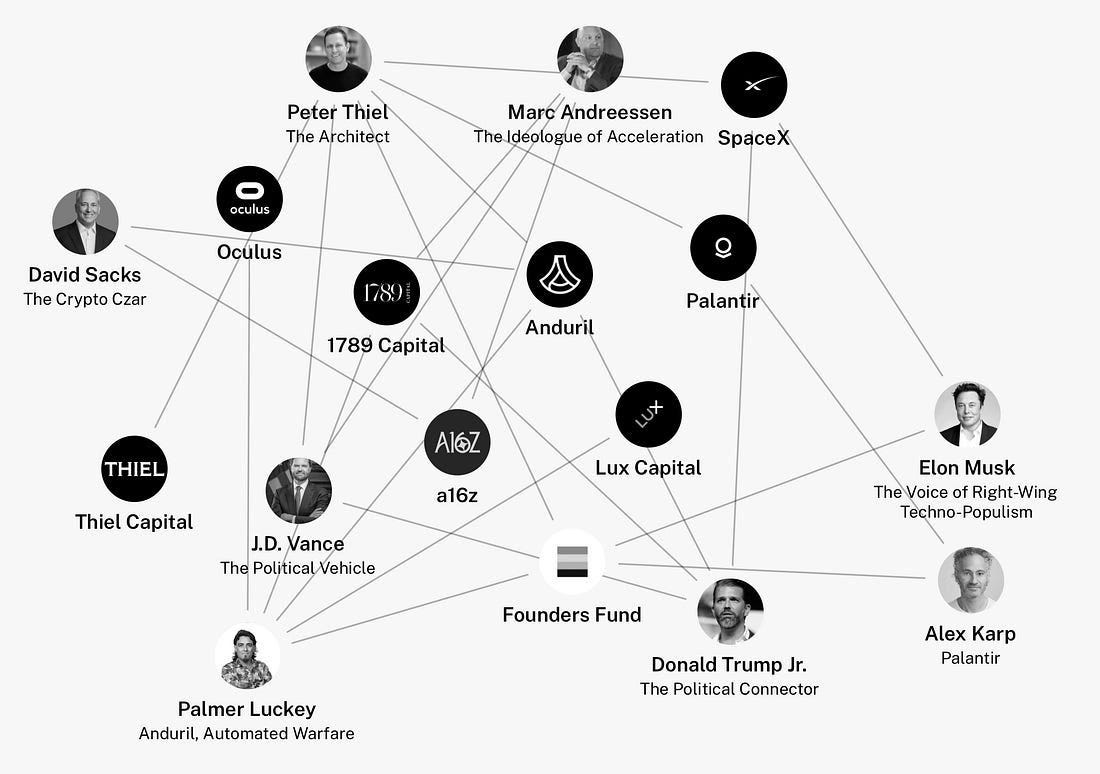
My disappointment soon turned to alarm in the weeks that followed, as I witnessed how Americans became increasingly subjected to the watchful eye of AI surveillance and drones in cities across the country — including Denver, LA, and Chicago — with minimal understanding of how these systems work, often in secret and without democratic consent. As Francesca Bria, honorary professor at University College London, shows in her project Authoritarian Stack, a deep network of oligarchs, capital, and digital systems is capturing our democratic infrastructure under the banner of AI and automation. The failures of traditional media, and our elected representatives, in challenging the narratives of Silicon Valley companies and executives have led us to this point.
It would take some time for me to realize, however, that there is a more significant undercurrent linking the legacy of Palantir and the New York Times, one that also involves the story of Jeffrey Epstein and his key role in the early development of the surveillance economy we all live under today. These connections have to do with the big business of mass-surveillance and hybrid warfare, as well as the way our media and data ecosystems dictate which narratives last, and which are forgotten; who gets celebrated and who gets cancelled; and eventually, who gets to live, and who gets to die.

II. Kill Chains & Hybrid Operations
I was once a storyteller in the AI industry. This role, uncommon when I started, is now considered one of the hottest in the AI jobs market, and involves using writing, design, and multimedia to explain and sell emerging technology. In this capacity at Palantir, my job introduced me to something I will never forget: the crude “art” of diagramming ISTAR systems, known as AI “kill chains.” These technical drawings, made with OV-1 diagrams in the Pentagon, convey how ISTAR tools — such as drones, satellites, ground stations, and command centers — come together to make decisions, including determining who to kill, and how to kill, using artificial intelligence.
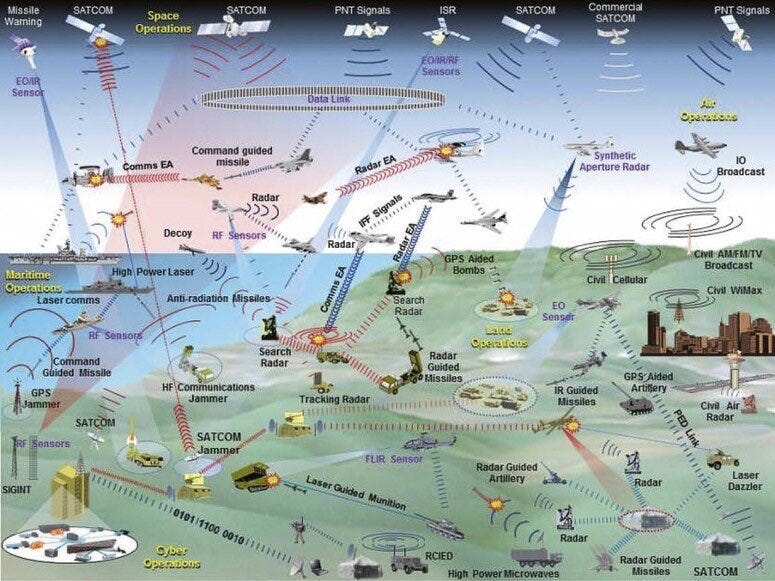
What I figured out while making these diagrams, however, was that drones and physical weapons only tell part of the story. When armies rely so much on data and automation, establishing all-encompassing surveillance dragnets soon becomes the utmost priority. The effort to map the world through satellites, drones, and information — in order to find targets and predict outcomes — eventually leads to the surveillance and mapping of what the military calls the “cognitive domain.” This entails charting public opinion, social media, influence, and reputation as a battlefield in itself. As digital warfare experts P. W. Singer and Emerson Brooking put it in their book, LikeWar:
“Power” on this battlefield is thus measured not by physical strength or high-tech hardware, but by the command of attention. The result is a contest of psychological and algorithmic manipulation… Your online attention and actions are thus both targets and ammunition in an unending series of skirmishes.
As a result, the internet has become a place where real wars with deadly consequences are carried out. Today, a tweet can determine a drone strike target, and kill civilians, halfway around the world. It can also empty an entire city, as Trump did in June when he cast Tehran into evacuation chaos after threatening airstrikes that never came. Now that the internet is a war zone, success largely depends on one’s ability to wield the power of information to mislead, misinform, or scare one’s enemies.
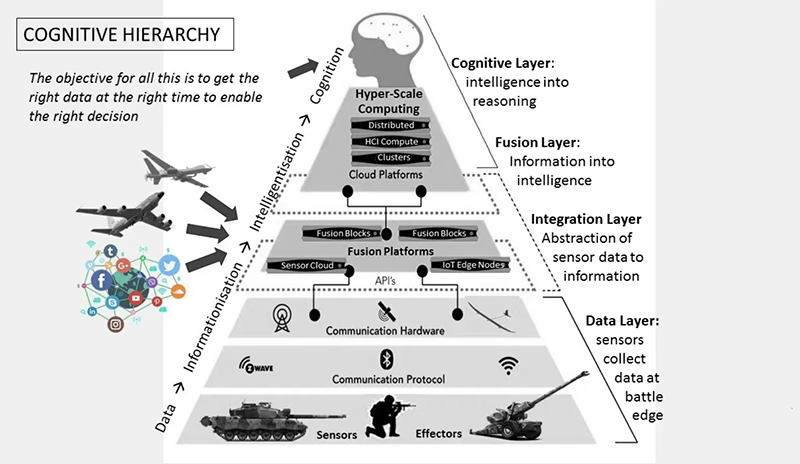
As a big-data platform with connections to the CIA and foreign intelligence operations, Palantir has likely been central to the waging of this kind of warfare: where nation-states try to win not only using conventional weapons, but by weaponizing data and influence for covert “hybrid” operations. Palantir’s executives understand this more than anyone. “The primary way to create peace in this world is to scare our adversaries when they wake up, when they go to bed, while they’re seeing their mistress,” Alex Karp has said. “The most effective way for social change is: humiliate your enemy and make them poor.”
What Karp refers to here are ways of “dealing” with someone without necessarily putting a bullet in their head; types of hybrid operations which are opened up by the possibility of exploiting personal data for combined intelligence and war operations. The vast amounts of data that we feed into the internet — about our lives, our location, our relationships, and our plans — can be used against us in ways we might not yet imagine. It is in the interest of many defense-tech companies like Palantir to help their clients figure out crueler and crueler ways to do so.
Projects with “irregular” components characteristic of hybrid operations include a Palantir proposal with HBGary to help Bank of America discredit journalist Glen Greenwald, as well as more complex intelligence and law enforcement operations like Operation Irish Goodbye, where ICE planned to capture immigrants voluntarily leaving through the Southern border to go home during the holidays.
Another example of hybrid operations featuring Palantir’s tools includes Operation Grim Reaper in 2024, where pagers were used to remotely bomb alleged Hezbollah operatives in Syria and Lebanon. The operation involved exploding phones that killed 32 people and injured over 3,000 others across Lebanon and Syria — including in their family homes. Two children would die and over 500 people would be left with severe eye injuries. “Such attacks could constitute war crimes of murder, attacking civilians, and launching indiscriminate attacks, in addition to violating the right to life,” UN experts said at the time. “It is also a war crime to commit violence intended to spread terror among civilians… A climate of fear now pervades everyday life in Lebanon.”
The weaponization of data through ISTAR — whether it is used to conduct direct “kinetic” drone strikes or compound “hybrid” attacks — is often indistinguishable from terrorism.

III. The Shadow of the Valley
I first got a sense of that terror last spring, not long after I helped author and publish a dissent letter with 13 other Palantir alumni. I was lying on the grass near the icy shore of a mountain, not far from Palantir’s headquarters in Denver, when I thought I heard the hum of a drone among the crackling ice.
My blood rushed with panic. I closed my eyes and imagined myself killed in an instant.
The feeling soon became familiar. I started watching my back constantly, turning my phone off when meeting friends. The recent and mysterious death of OpenAI whistleblower Suchir Balaji could have been enough to spook someone in a situation like mine: where they were questioning one of the largest AI companies in the world. But unlike OpenAI, Palantir’s CEO publicly talks about killing people, and has fantasized about poisoning critics using covert methods such as fentanyl-laced drone strikes. Palantir’s executives are also vocal about wanting to flex the definition of terrorism to include their enemies, as Palantir’s Defense chief Mike Gallagher did on Fox News when he called for the feminist group Code Pink to be classified as domestic terrorists.
My experience, nonetheless, pales in comparison to migrants, foreign students, or others already trapped under AI surveillance. As reporter Mohammed R. Mhawish wrote in his soul-crushing retelling of the exploitation of surveillance in Gaza for New York Magazine:
“The campaign of mass killing, of severing communities, of making homes unlivable… operated, too, through a system of watching, knowing, and collecting us: drones that hovered endlessly overhead, quadcopters that dipped near windows and entered houses, facial-recognition scans at checkpoints, movements followed through phone tracking, calls that broke with static before an air strike. The Israeli army was using artificial intelligence to generate kill lists, monitoring our social-media accounts, and storing in bulk the audio of our phone calls.”
American companies like Microsoft, Google, Amazon, and Palantir have contributed to this oppression by hosting and exploiting surveillance data for the IDF, leading to the development of gruesome applications like Where’s Daddy — a tool which allegedly follows Hamas targets to their family homes in order to deal maximum damage through drone strikes.
At first, my main reason for speaking out was the moral injury of seeing what was happening in Gaza. This would not last long. It would take less than a few months after that spring day in the mountains for the mayor of Denver to undemocratically re-sign a contract, rejected unanimously by city council, to bring self-launching Flock police drones into the city. In a pilot in October, Denver Police flew over a dozen Skydio drones within a three-block radius of my house.

The surveillance regime that Silicon Valley has cast upon Gaza now extends far beyond the Middle East, as ISTAR tools become commonplace in our country. Yet the origin of this world we live in is not to be found either in Palo Alto or Tel Aviv — but the island of Little St. James.
As Reason, The San Francisco Standard and DropSite News report, Jeffrey Epstein was a key power-player standing between Silicon Valley and Israel a decade ago, and connected Peter Thiel to former Israeli prime minister-turned-businessman Ehud Barak. Leaked emails show Epstein played a crucial role in raising big money for American and Israeli cyberweapons companies — including $40 million for Thiel’s VC firm, Valar Ventures. These investments would help spur a surveillance industry that, years later, has pushed AI targeting technology beyond warfare uses and towards civilian and corporate contexts. “I’ve been surprised how many corporations are looking for a new military-like perspective on management,” Epstein wrote to Barak. “A corporation is not dissimilar from defense forces.”
“No tech company surfaces more often — or draws more interest from Israeli figures — than Palantir,” the SF Standard reports.
More leaks and reporting by the Intercept also revealed that, around the same time Epstein, Thiel, and Barak were in contact, New York Times reporter Landon Thomas Jr. was also in communication with Epstein. He tipped off the convicted child sex offender regarding an investigation by another journalist, and failed to investigate offers from Epstein of compromising information, and picture evidence, of Trump’s relationships to younger women. This manipulating and gatekeeping of stories, revealed over a decade later, shows how narratives that protect the rich and powerful are woven behind the scenes.
From our perspective today, the New York Times and Palantir’s software are representative, respectively, of the mediation of “truth” in the ages of mass media and information technology. Through their “investigations” and gatekeeping of information, they embody attempts to own facts and arbiter justice, to be the system of record for the most important institutions and decision-makers in the world. Just as Palantir’s software can set algorithmic thresholds to define who is a target, and justify their killing, the New York Times sets the narratives that allow this killing to continue — to absolve genocide, justify war, define “terrorism,” and perpetuate international aggression. Nonetheless, as both continue to enable genocide in Palestine, or stoke fire for war with Venezuela, people are wising up to the ways in which these corporations weaponize information to protect, and enrich, those in power.
IV. Criminalizing Surveillance Resistance
It’s rush hour in Denver, and I’m using my last quarter-tank of gas to drive to the ICE GEO Detention Center in Aurora. It’s now October, and I can barely see the road ahead as a storm picks up and my eyes sting from super-glue fumes, the result of a last-minute attempt to fix my only pair of glasses. I don’t have cash to buy new ones, or sort the emergency lights that light the cabin, but these are the least of my concerns.
I am late to give a short speech in front of ICE, and I am the Antichrist.
That is, at least, what Peter Thiel would want you to (laughably) believe. Seizing on momentum from his New York Times interview, Thiel held four private lectures on the subject in San Francisco, fanning the flames of his religious conspiracy until everyone from the Washington Post to South Park was talking about it. In these talks, Thiel argued that the Antichrist would be a young person who, like me, is under 33, advocates for AI regulation, and identifies as a Luddite: someone who wants to hold technology owners responsible for the harms they cause.
As Professor Elke Schwarz writes in Opinio Juris, this attempt to demonize opponents of AI aims to build a “spiritual narrative” that bolsters the wealth of investors. “To create belief in a technology is to sacralize the capacity of a startup to deliver this quasi divine technology and this, in turn serves to elevate the valuation of such a company,” she writes.
Since I couldn’t work with the New York Times on a retort, I worked with The Guardian to release an op-ed explaining ISTAR technology and condemning ICE for their unconstitutional surveillance. This threat, however, demanded much more than words. I soon stopped focusing on media and writing, and worked to build deeper roots with organizing networks in Denver and New York that had long been challenging Palantir, Silicon Valley, and our corrupted defense-industrial complex. In Denver, I helped lead a small and peaceful march towards Palantir’s HQ in support of Palestine and in opposition to ICE surveillance. There, we were followed by drones and dozens of police (at least one per protester) to find a wall of tactical units in full militarized gear and equipment protecting the surveillance giant — an incredible show of force and expense of city funds. In contrast, a similar protest in Seattle with around a thousand people would draw no police response.
In August, I would testify at the Colorado State Senate in defense of the first comprehensive statewide regulations of AI in the country.
“opposing the main force bringing unconstitutional surveillance technology in our country, ICE, can now land your name in an FBI watchlist — effectively criminalizing the fight against surveillance in America.”
Now, the situation has reached fever pitch. Attorney General Pam Bondi ordered the FBI to create a list of domestic terrorists that includes people standing up against fascism and immigration enforcement. That means that opposing the main force that is bringing unconstitutional surveillance technology in our country, ICE, can now land your name in an FBI watchlist — effectively criminalizing the fight against surveillance in America. The memo also aims to establish a “cash reward system” for information, meaning the FBI could soon pay off my own neighbors to put me and other organizers on a watchlist, allowing the government to start using their surveillance tools — potentially including Flock and Palantir — against us.
While I suspected this kind of retaliation since I’ve started speaking out against Palantir in February, this is now also the reality of hundreds of thousands of activists opposing fascism, unconstitutional raids, and immigration enforcement across the country. The same ISTAR surveillance weapons that led to the arrest of student protestors, the deportation of immigrants to foreign concentration camps, and to a ruthless regime of slaughter and surveillance in Gaza, now threaten untold millions of Americans. Bondi’s memo, which has not been reported on by the New York Times, is “a declaration of war on just about anyone who isn’t MAGA” according to Ken Klippenstein, the independent journalist who broke the story.
Upon arriving the gates of the ICE GEO Detention Center in October, I came across a crowd of neighbors standing between the facility walls and a wooded creek across the street. On some days, a friend told me, one could see the shadows of inmates’ hands as they felt out for those of their loved ones outside.
In a matter of moments, I was called to share a few words at the footsteps of the ICE facility.

V. 5th Generation War
I’m publishing this essay the week after Venezuela’s President, Nicolás Maduro, was kidnapped by American forces, and after the first bombing of a South American city by the USA in history, a world I’d never think I’d live to see. There is an overwhelming sense of confusion amongst almost everyone now, including many journalists — something which is likely by design. As we have seen, we have moved to forms of warfare that are not understood by the public, which heavily rely on AI surveillance, narrative control and deception, the exploitation of social media, and the design of increasingly unusual, and cruel, methods of punishment and killing.
The invasion of Venezuela is a perfect example of this kind of warfare, which has also been termed Fifth Generation Warfare (5GW) by military experts. According to Professor Armin Krishnan in his book Fifth Generation Warfare: Dominating the Human Domain, 5GW is the latest, most secretive, and difficult to understand form of war. Daniel Abbot’s Handbook of 5GW defines it as “an emerging theory of warfare premised upon manipulation of multiple economic, political, social and military forces in multiple domains.” This manipulation involves the oversight of all fighting domains — land, air, maritime, space, cyber, and cognitive — through what is termed a “common operating picture.” This unified view is made possible by Pentagon projects including Project Maven (which pioneered AI targeting), Joint All-Domain Command and Control (or JADC2, which connects sensors from across the armed forces) and software built by Palantir and a constellation of defense primes and tech startups.
We can see in the invasion of Venezuela some hallmarks of 5GW, as offered by Krishnan:
Fifth generation warfare bypasses the battlefield and targets society as a whole, rather than its military forces.
Violence in 5GW is very dispersed or hidden, which makes it difficult to perceive as war.
Fifth generation warfare relies on covert or ambiguous means that hide nefarious activities or disguise them as benign or harmless.
The objective of 5GW is to overthrow an existing political order or change the culture in a society in accordance with the goals of the aggressor.
According to Krishnan, 5GW “shifts the emphasis from the control of physical terrain to the control of the human terrain and the human mind as a target of attack.” This means that the capture of President Maduro, under the cover of law enforcement, is only the beginning of the operation. The real battle begins afterwards, in the campaign to legitimize the kidnapping, manufacture consent for similar interventions in the future, and to pull one of two reactions from you, the witness: increased favor, or fear, of the administration.
The worse after effect of 5GW is that it turns everyone, at home and abroad, into a subject of war.
The outsized role of social media in the Venezuela incident is clear. In war-room pictures released by the White House, we can see Marco Rubio, Donald Trump, Pete Hegseth and others monitoring an OSINT (Open Source Intelligence) account on X. In the aftermath of the presidential kidnapping, official government accounts blasted propaganda parading the image of Maduro and remixing press conference clips with music. These hype-videos have far more in common with what I see Palantir and its officers posting on social media than anything I’ve ever seen from official government accounts. The objective is clear: to drive fear, awe, and uncertainty to mask the next move.
In the world of hybrid warfare, however, it takes two to tango: the government and the media. After the assault in Venezuela, Fox News and the Wall Street Journal constantly failed to mention the dozens of bystanders harmed or killed in the invasion of Venezuela, including a 78-year old woman killed after her public housing complex was shredded by American bombs. They are creating the same conditions that allowed victims in the Gaza conflict to receive sub-human treatment in the media, enabling their easy slaughter and oblivion, and allowing Americans to quickly forget the consequences of interventionism. The New York Times provided even more critical assistance: it refused to report on the incursion when it was tipped-off ahead of time, providing cover for the administration’s illegal acts, potentially enabling war crimes while violating its own ethical code to stand for the truth no matter the circumstances.
When the media fails to do its job, or to question modern military forces and events through the lens of contemporary doctrines like 5GW, it reflects a misunderstanding of how war is waged today, and serves as little more than an accomplice.

It has now become increasingly clear that we have two paths before us as a country. The first, where we continue allowing truth and “facts” to be guarded and weaponized by media and technology elites. The second, where we wake up and break free from their control. When we re-establish our constitutional rights, start legislating AI seriously, and bring justice to the billionaires behind the weaponization of AI surveillance for profit and control.
My organizing work showed me, that after months speaking to reporters and isolating myself, I was not alone. People who I encountered, young and old, wealthy or not, and from any background, are starting to realize that our fractured attention, our sense of uncertainty, our political divisions — as much as the worst humanitarian crimes today — are all made possible thanks to tech billionaires that use the internet, and our personal devices and social media platforms, to harvest and exploit our information, behaviors, and beliefs. They are realizing that social media is part of a bigger weapon (ISTAR) where people’s everyday movements, relationships, and communications can eventually be turned against them — something that explains why executives in Meta, OpenAI, and Palantir recently joined the Army as officers.
We are also waking up to the fact that it hasn’t always been this way: this sea change in our relationship to technology has happened in less than twenty years, and has been led by a very small group of Silicon Valley executives that have unchecked power in influencing both government, and our personal lives, today.
Organizations and movements around the country are responding to this realization, and taking different angles of approach. They are emerging from high schools, college clubs, local moms meet-ups, discussion groups, research labs, neighborhood associations, and tech-worker coalitions in cities around the country. They include Appstinence, Delete Day, Screen Time Action Network, The Strother School of Radical Attention, Lamp Club, Ludd Club, Landline Kids, Design it for Us, Reconnect, No Tech for Apartheid, No Flock, Louis Rossmann’s Clippy movement, the Center for Humane Technology, AI Now and a de-centralized, but highly organized, data center “rebellion” that is happening in local communities nationwide.
While there might be a long road ahead to untangle big tech’s webs of influence and control, there is hope. As Singer and Brooking put it in LikeWar:
These new wars are not won by missiles and bombs, but by those able to shape the story lines that frame our understanding, to provoke the responses that impel us to action, to connect with us at the most personal level, to build a sense of fellowship, and to organize to do it all on a global scale, again and again.

Epilogue: The Antichrist Responds to the Antichrist Lectures
The following is an abridged version of the speech I gave in October, at the ICE GEO Detention Center in Aurora.
My name is Juan Sebastian Pinto, and I am a writer, organizer, and a former employee of the surveillance company Palantir, based here in Denver, which is currently providing its AI services to ICE, enabling the humanitarian crimes that are committed here.
Allow me to re-frame that: Palantir helps the government break up families in the city it calls home, with your tax-payer money.
It took me a long time to get here. My early story is not unlike that of Eric Sanchez Goitia, who was imprisoned here and later deported to Venezuela. Like me, Eric came here legally around the age of 11 and built his entire life and family in Colorado. He fled the instability, deep poverty and crime of his home country of Venezuela, partly enabled by brutal US sanctions. Now he is separated from his wife, Desiree, and his community, thanks to ICE and the Department of Homeland Security. Now, Trump is threatening his country with covert-operations, assassinations, and war.
In his story, I see my beliefs and aspirations as an immigrant shattered. I see the destruction of the American dream as many millions have conceived of it.
There is a reason there is a war on immigrants. Immigrants understand freedom. They seek it. They will go to the greatest lengths to achieve it. But when the government is wielding surveillance technology, social media, and the DHS to make everyone’s life paranoid, hateful, and divided — it has declared war not only on us — but on all of its people, and is acting no different to the terrorists it claims to oppose.
For a long time now, intelligence agencies, academics, and companies like Palantir have recognized that social media threats and snuff films can be used as weapons of war — tactics originally pioneered by ISIS and MS13* — but now that weapon is pointed at us. Not only is the DHS and administration using social media to track people, but also to push racist memes, AI-produced images, and explicit threats in support of white supremacy. Countless drone strike clips and AI-generated images shared on social media — depicting and mocking humanitarian crimes from Yemen to the Caribbean — aim to stir outrage, desensitize us, manufacture consent for war, and sow fear among neighbors.
That’s why we need our representatives to stand up and make Colorado the leading voice in support of AI regulation. We have to help our entire nation defend its constitution — and just like we pushed pioneering legislation many times before — we must push the envelope of civil rights to protect our country from AI surveillance and ICE.
I did not read my speech well, nor could I make out all the words in the rain. There was an air of anguish, amplified by the storm, that I could not get through. But then I took some time to look at the faces of everyone around me. The antichrist was nowhere to be found among us. There was, instead, a tight band of climate, peace, and labor activists and concerned neighbors; carpenters, electricians, tech workers, artists and musicians; fathers and grandmothers who came every week to support their friends and family inside the walls. People with whom I’ve been chased in protests with drones and militarized police. People who have shut down the streets of Denver to say no to surveillance and economies of exploitation, war, and internment.
They were not people who believed — as Palantir CEO Alex Karp said recently — that “patriotism will make you rich.” They know that loving this country, its people, its constitution and our freedoms does not come cheaply. That sometimes it costs everything, your money, your reputation, maybe even your life.
Thank you for reading
Ziggurat will keep on casting a light on the threats that big tech and AI pose for our constitution and human rights. Through education and advocacy, we are fighting for a world where we will not be continually alienated and misinformed, or worse, flung into dangerous wars that could devastate future generations.
We all deserve better, and we all deserve to know what is happening, especially when the media seems to be, intentionally or unwittingly, conspiring with big tech and billionaires to make us accept mass surveillance and constant war. Today, I am working with Colorado advocates in support of peace and in defense of the country’s first comprehensive regulations on AI, and with activists in cities around the country to help fight the invading threat of police drones and data centers through education and civic engagement.
We are stepping on the toes of multi-billionaires, millions of dollars of lobbying, and possibly, the administration’s authoritarian objectives. That’s why we must stand together. If you have made it this far and found this information useful, this essay is more than just an opinion piece, it is an invitation to start a conversation and take action. If you are tired of being a passive observer, or target for influence, in these wars — I encourage you to subscribe, share this message, and reach out. We have power in numbers, persistence, and community — and there is much more to come.
I also encourage you to follow our national movement, Against Machines, and to stay tuned for a new project: Offline Underground, a print-only publication and event guide which aims to connect movements battling big tech across the country — available via paid subscription here, and coming for free to a subway station near you.
Wow. Very comprehensive - and very depressing to see how far their madness has already gone. We have to find and create ways to avoid capture. Thank you for explaining your experiences and insights.
So depressing. And I wish there was some kind of comprehensive guide to "how to act online in the age of mass surveillance." Do I withdraw from all social media? Privilege some over others (which??)? But then how to use them to send the world the messages we want to send? Social media has enabled me to learn so much...and how to get away from companies lile Google when we depend on them for everything? I've never been a tech-savvy person. All this scares me and I don't know what to do.